
How Do You Measure a Man?
September 3, 2026
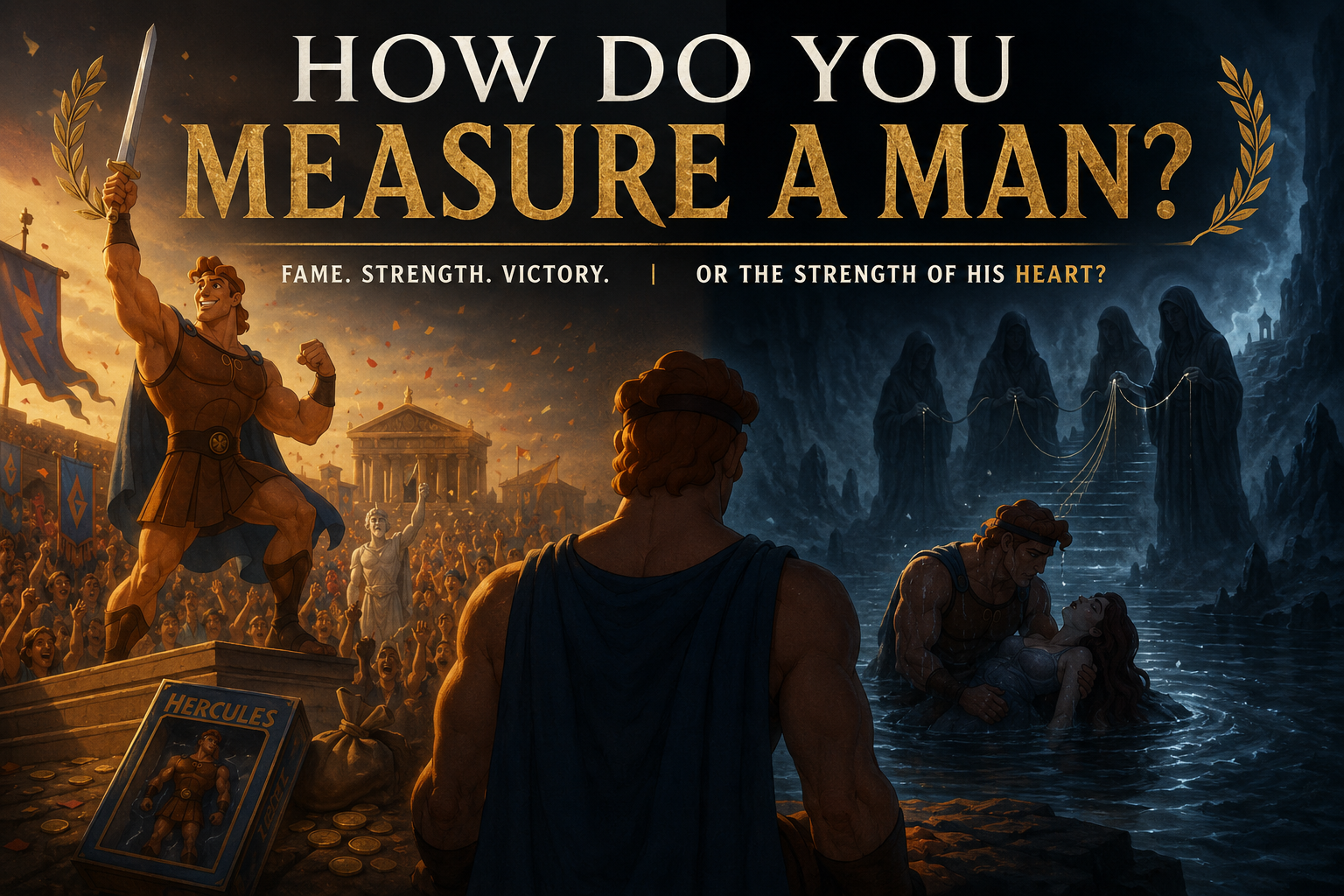
Stories have always been one of the ways we pass along what we value. They come to us through books, movies, fairy tales, animation, and even video games. Some are profound, others are shallow, but the medium itself doesn't determine the value of the story.
Sometimes underestimate stories made primarily for children, incorrectly determining that they have little to offer. We may outgrow parts of them, but the best ones have a way of growing with us. They teach us as children and continue to challenge us as adults.
Hercules has been one of those stories for me.
Going the Distance
After Hercules is given his mission, he begins training to be a hero. He finds a mentor who develops him so he has the physical and mental tools to succeed. Now that he is ready, it is time to prove himself against the Hydra.
After cutting off head after head, Hercules barely defeats the Hydra. This kicks off a series of victories that makes him the most famous man in all of Greece.
He finally has the crowd cheering for him.
One night in the temple of Zeus, Hercules is telling his father about his latest victory. As he concludes the story, Zeus expresses his pride in Hercules. Beaming, Hercules turns to his father and says he has been waiting his whole life to hear this.
Zeus asks what Hercules has waited to hear, to which Hercules says that he will finally have the chance to join the gods.
With sadness in his eyes, Zeus says that Hercules has done great things, but he isn’t quite there. He isn’t a true hero.
Hercules is shocked. He lists off his accolades: he has defeated every monster he has faced, he is the most famous man in Greece, and he even has an action figure. Zeus says that those things do not make him a true hero. Something is missing that Hercules has to discover for himself.
How Do We Measure Success?
This scene hit me hard.
Hercules had success, fame, and money. These were things I held up as clear indications of success. It also reminded me of the times when I felt that I did everything right, but it still wasn’t enough. Instead of things flourishing, they just fell apart.
The response from Zeus begs the question: what makes someone a true hero?
This can lead to a deeper question for us: How do we measure success?
We often look at a bank account, the number of direct reports someone has, the size of their house, or the praise others heap on a person. While there is nothing wrong with power, wealth, or influence, we all know that they can leave us hollow.
Success is great, but it can leave us wanting more. These externals cannot define success.
Returning to Hercules, we see his frustration. His fame and daily activities have lost their luster. His mentor expresses his trust in Hercules and his ability to go the distance.
With renewed vision, Hercules continues to face the trials that come his way. He loses his strength, beats a Titan, regains his strength, and frees the gods, including Zeus, from a takeover plot.
Through these continued victories, he still has not proved himself a true hero.
The Strength of His Heart
Then he learns that the woman he loves, Meg, has died. Her soul has gone to the Underworld. Willing to sacrifice his own life, Hercules jumps into the pool of souls to retrieve hers.
As he swims toward Meg’s soul, the Fates prepare to cut his thread of life. Hercules quickly ages in the pool. The Fates go to cut his thread, but it suddenly turns bright gold, incapable of being cut.
His sacrifice to save Meg is the moment he becomes a true hero.
Hercules emerges from the pool, travels to Meg, and places her soul back in her body. He then is whisked away to Mt. Olympus, where Zeus tells him the secret:
“For a true hero isn't measured by the size of his strength, but by the strength of his heart.”
The first part that stood out to me was Hercules sacrificing himself for Meg. It consistently reminded me of Jesus sacrificing Himself for me.
My soul has been lost at times due to my sins. Jesus doesn’t walk away from me. Instead, He enters the world, faces death to seek out my soul and save me. Hercules rising from the pool with Meg’s soul became a picture of Jesus carrying my soul.
The second part is Zeus telling Hercules what makes someone a true hero.
Strength is great. Wisdom is great. Knowledge is great. But the true mark of a hero is the heart.
This was the same lesson I heard from the Bible. People judge by the exterior, but God judges the heart. He knows who we truly are. Hercules drove that point home for me.
If our heart is not right, the rest is for naught.
Zeus’ line about the strength of heart leaves us with two questions.
What makes a heart strong?
This is one of those questions I have pondered for years.
The other is:
What do we love with our heart?
That is a question we have to ask ourselves daily.
Weekly Challenge
Take a few minutes this week to examine your heart.
Ask yourself two questions: What does it mean to have a strong heart? And what do I love with it?
Look beyond the external measures of success. Your job, income, accomplishments, influence, and reputation may tell you something about what you have achieved, but they cannot tell you who you are.
Instead, look at what you love. Where do you give your time? What are you willing to sacrifice for? What occupies your thoughts? Most importantly, where does God fit among those loves?
Choose one concrete way this week to strengthen your heart by loving God or someone He has placed in your life more intentionally.
Forge Ahead
Anvil: the place of formation.
Arrow: the mission we’re sent on.
The world needs more men formed in virtue. Forward this to a brother who’s ready to grow.
Know someone who would benefit from this letter?
Send it to a friend, brother, or fellow traveler who may need it today.
Continue with a related letter
Follow a shared story, continue a related lesson, or take a different road.
A Story That Followed Me Home
Mental Models #2: Learning to Walk
Watching a child learn to walk offers a new way to understand virtue, our stumbles and falls, and the patient love of God the Father.